 ShizuStore
XFiles
1.5.0 · GitHub
More about this app
Offline file manager with root and Shizuku support for full filesystem access

XFiles
An offline, open-source Android file manager with X-plore's workflow — dual-pane tree browsing, archive-as-folder, app manager, APK/AAB/XAPK install, root & Shizuku access — on the latest Android stack with a Material 3 Expressive UI.


-3DDC84?logo=android&logoColor=white)


English · 简体中文

Real capture on a OnePlus 7 Pro (Android 16), sped up. One run: file copy → App manager (an app's components & APK splits) → Root (the real filesystem, /data and all).
Why
- X-plore broke on Waydroid over the past half-year; I needed a replacement.
- It's the LLM era — if a tool doesn't fit, build your own.
- Software with dangerous root powers should be open-source, fully offline, and
collect nothing. XFiles has no
INTERNETpermission and no analytics.
Download
Grab an APK from Releases:
vX.Y— stable, cut wheneverversionNameis bumped.nightly— a single rolling prerelease, refreshed on every push tomain.
Requires Android 8.0 (API 26) or newer. On first launch, grant All files access (the app deep-links to the system page). Or build it yourself.
Features
Dual-pane tree browser
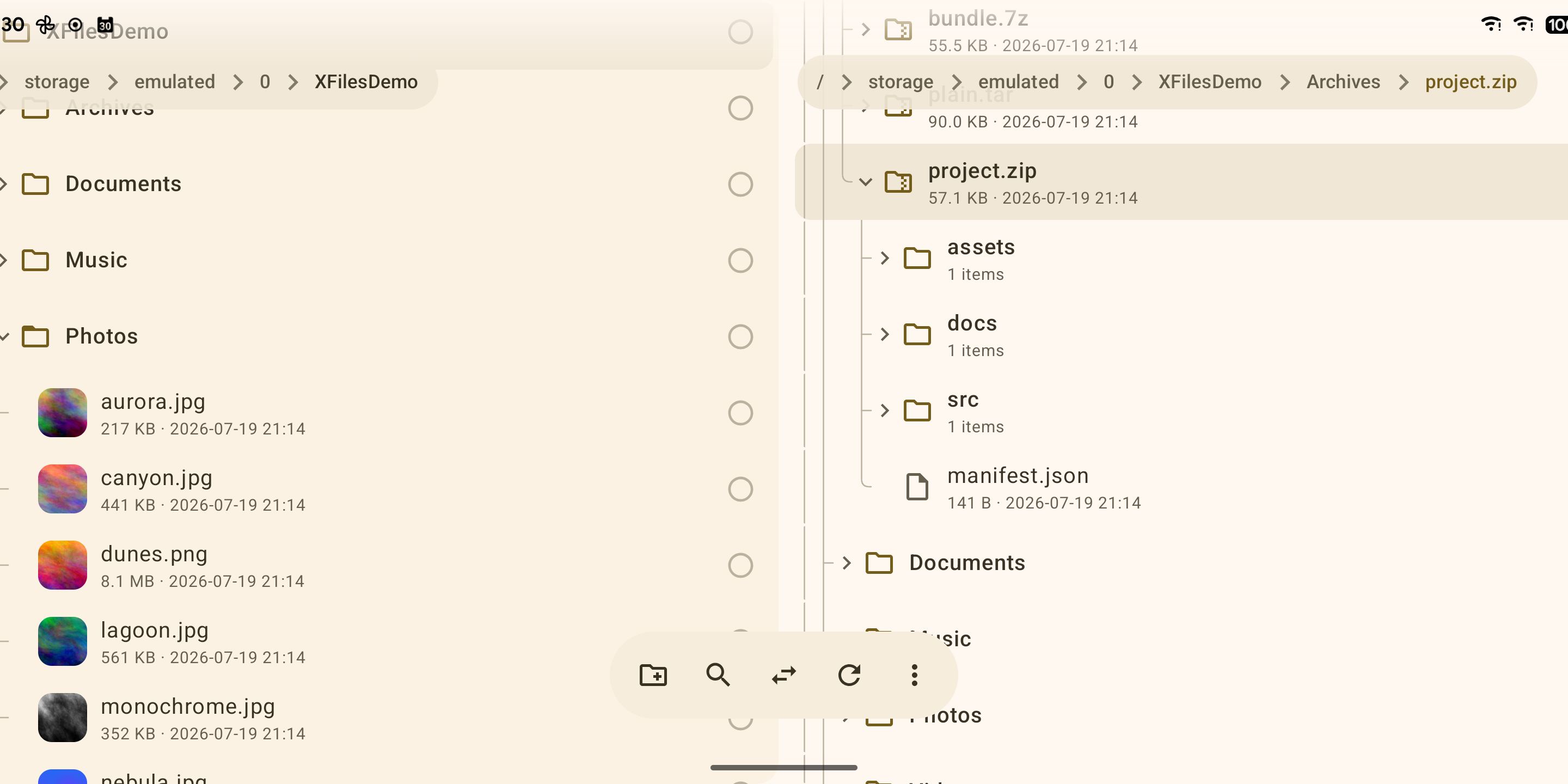
X-plore's signature: two independent panes — side-by-side on wide screens, a swipeable pager on phones. Folders expand in place as a tree with indent guide lines, and each pane carries its own floating breadcrumb pill. On phones, a target chip at the top keeps the hidden pane's folder visible and switches to that pane when tapped.
Archives sit in the tree like any other folder — the breadcrumb descends straight into
project.zip.
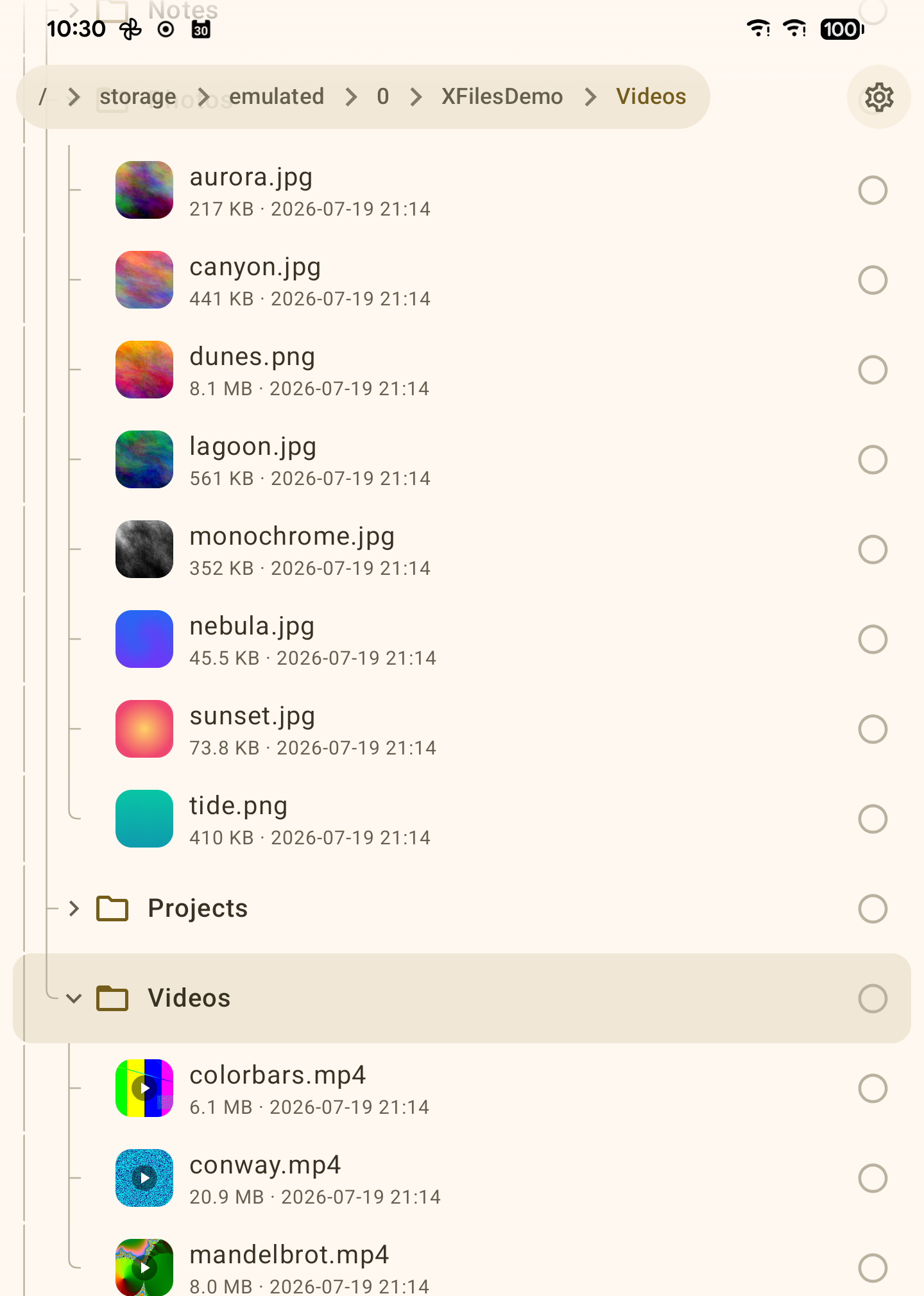
Thumbnails in the tree
Images and video poster frames render inline. Video frames are extracted once at thumbnail size and disk-cached, so they are instant after a restart, with a play badge and an icon fallback while loading.
File operations
Multi-select via right-edge checkmarks. The other pane is the destination for
copy, move, zip and extract: set its folder, return to the source pane, then run the
operation directly. Copy to…/Move to… in the long-press menu remain available when
you want a one-off explicit destination. Delete on internal storage, an SD card, or a USB
drive moves the files to the Recycle Bin, where they can be restored. Empty Recycle Bin,
and delete under Root or a network location, remove them permanently. Plus rename and
new folder. Mounted USB
OTG drives appear as pane roots next to internal storage and SD cards, and the list
updates when a drive is plugged or unplugged. On Android 8–10, writes to SD cards, USB
drives and other secondary volumes work through a one-time SAF grant.
Add location (home screen or Settings) grants a document tree from another app —
RSAF (rclone), CIFS Documents Provider, Nextcloud, or any DocumentsProvider — and
pins it as a pane root. Copy and move then stream through the system; XFiles still has
no INTERNET permission, so the other app is what actually talks to the network. A
tree that is already local storage is pinned as a favorite instead of a duplicate root.
Step-by-step: Add a network location
(source).
A background engine drives it all with progress (the wavy Expressive indicator), cancellation, and Skip / Overwrite / Keep-both conflict resolution.
High-performance zip
Creation deflates every entry across all CPU cores (commons-compress
ParallelScatterZipCreator, STORE for already-compressed media). Extraction runs one
ZipFile handle per worker off a shared queue. Zip-Slip guarded; falls back to
single-threaded streaming when temp space is tight.
Foreground service
Long copy/move/zip/extract operations keep running when the app is backgrounded, shown in an ongoing notification with a Cancel action and a wake lock. The service self-stops when idle.
Archives as folders
Browse zip/jar/apk, 7z, tar(.gz/.bz2/.xz) and rar read-only; extract by copying out. Anything installable installs from right there — see below.
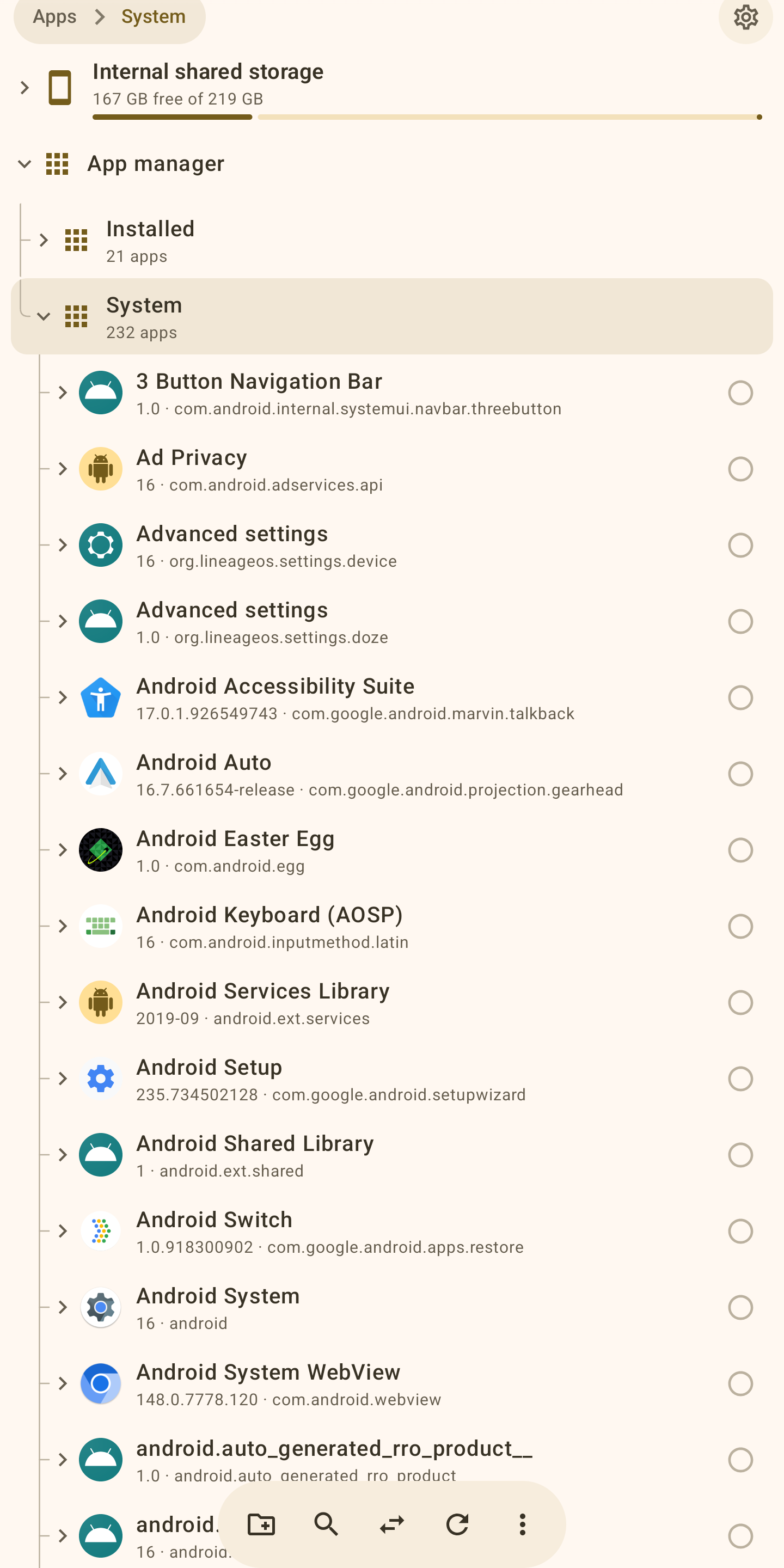
App manager
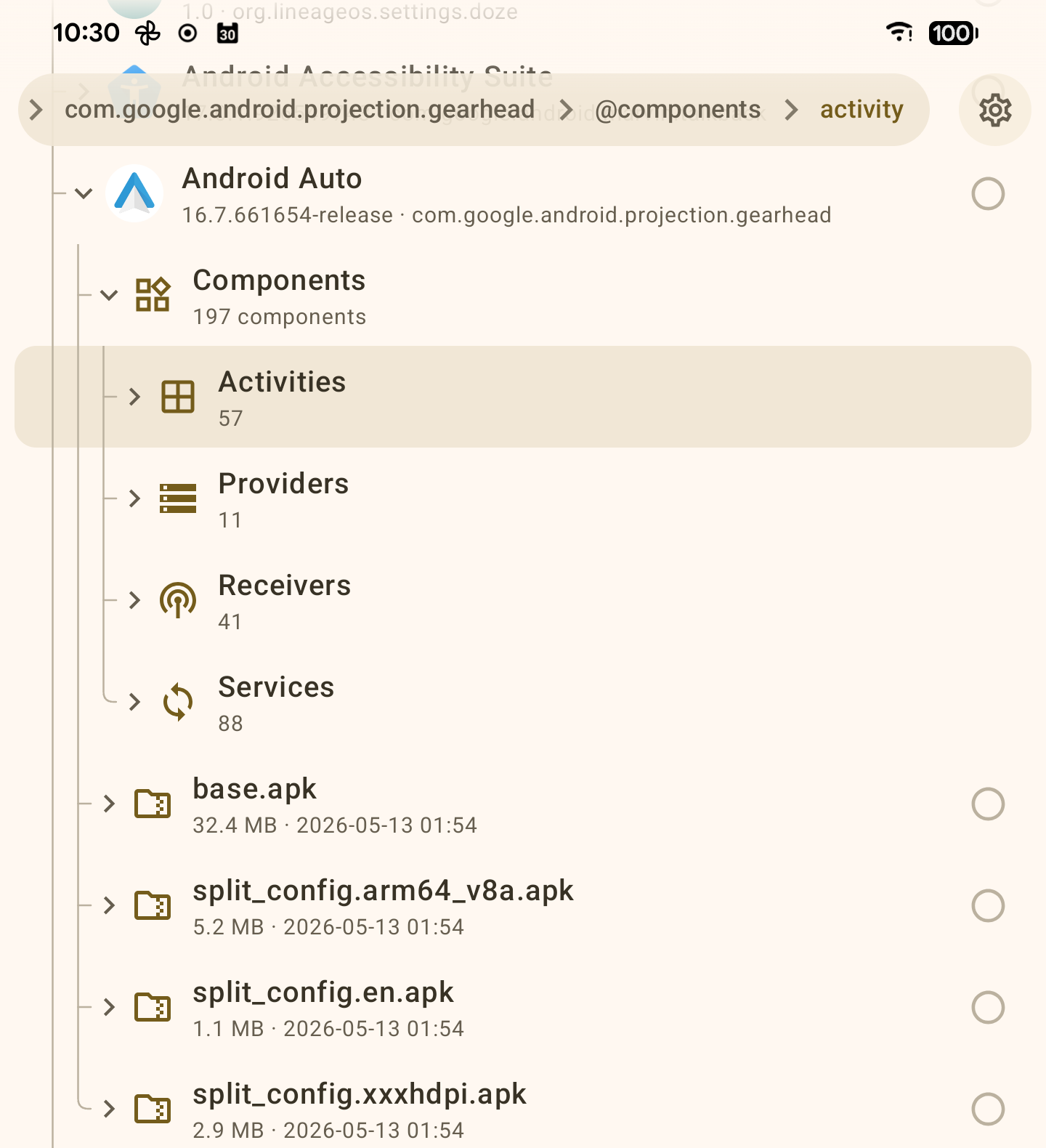
Installed and system apps in two groups, with real icons, version/package badges and rich details. Install, launch, uninstall, or copy an APK out to share an app as a file.
Expand an app and you get everything that belongs to it in one place: a Components
node broken down into activities / providers / receivers / services, plus base.apk and
every split_config.* APK — each one expandable, because an APK is just a zip.
Drill into a category and each component shows its class name and its real manifest
state — exported / not exported, enabled / disabled. Launch activities, create
shortcuts, and enable/disable components where the system permits.
Package installer
APKs install with a tap — and so does everything APK-shaped: split bundles
(.apks / .apkm / .xapk, with XAPK OBB expansion files placed where the game
expects them) and even raw .aab files. A vendored
bundletool converts the bundle on the phone
into split APKs matched to the device and signs them with a built-in certificate — no
PC, no Play Store. Installs run in the foreground service, so backgrounding the app
mid-install doesn't kill the session.
Root & Shizuku
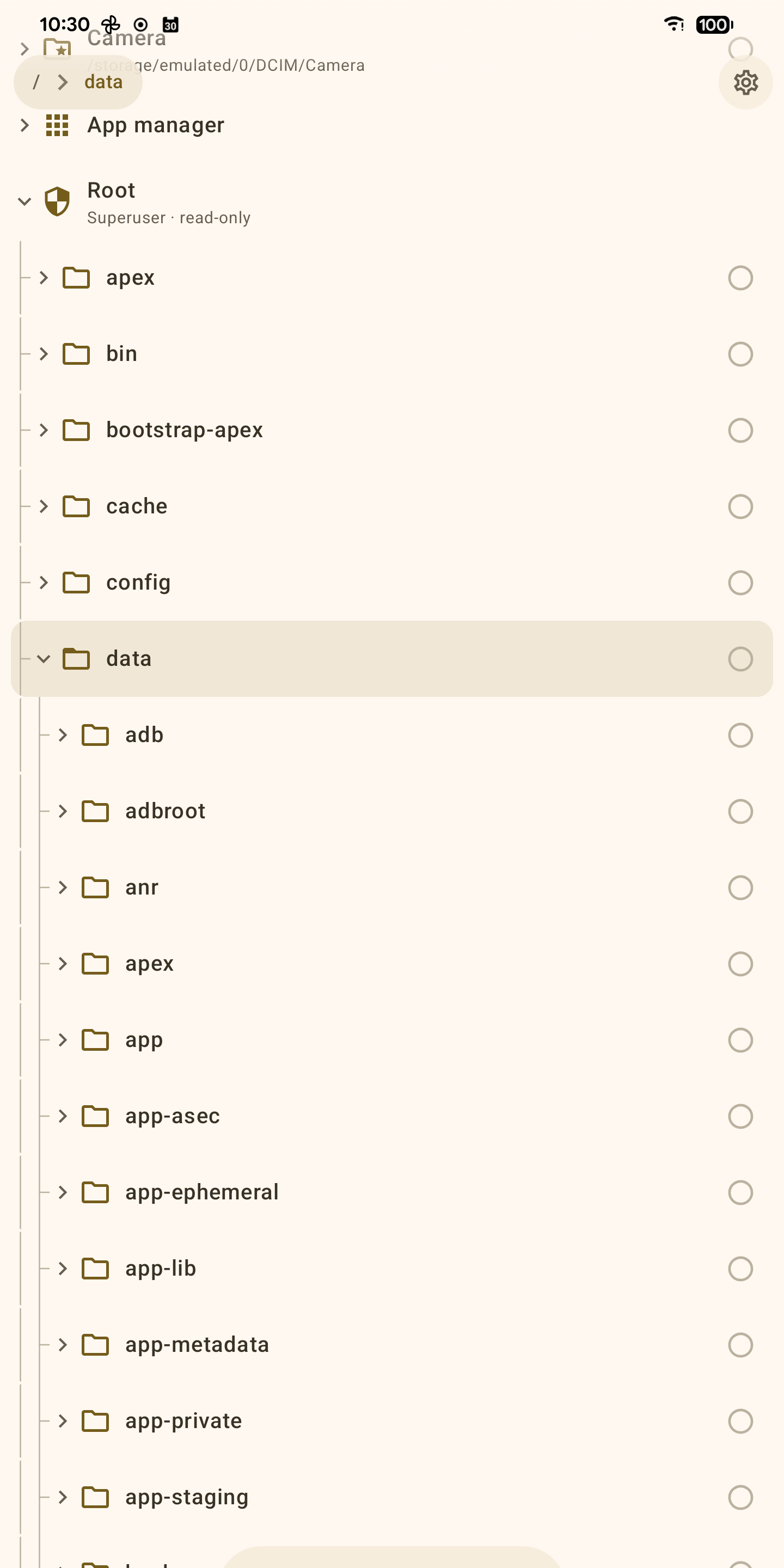
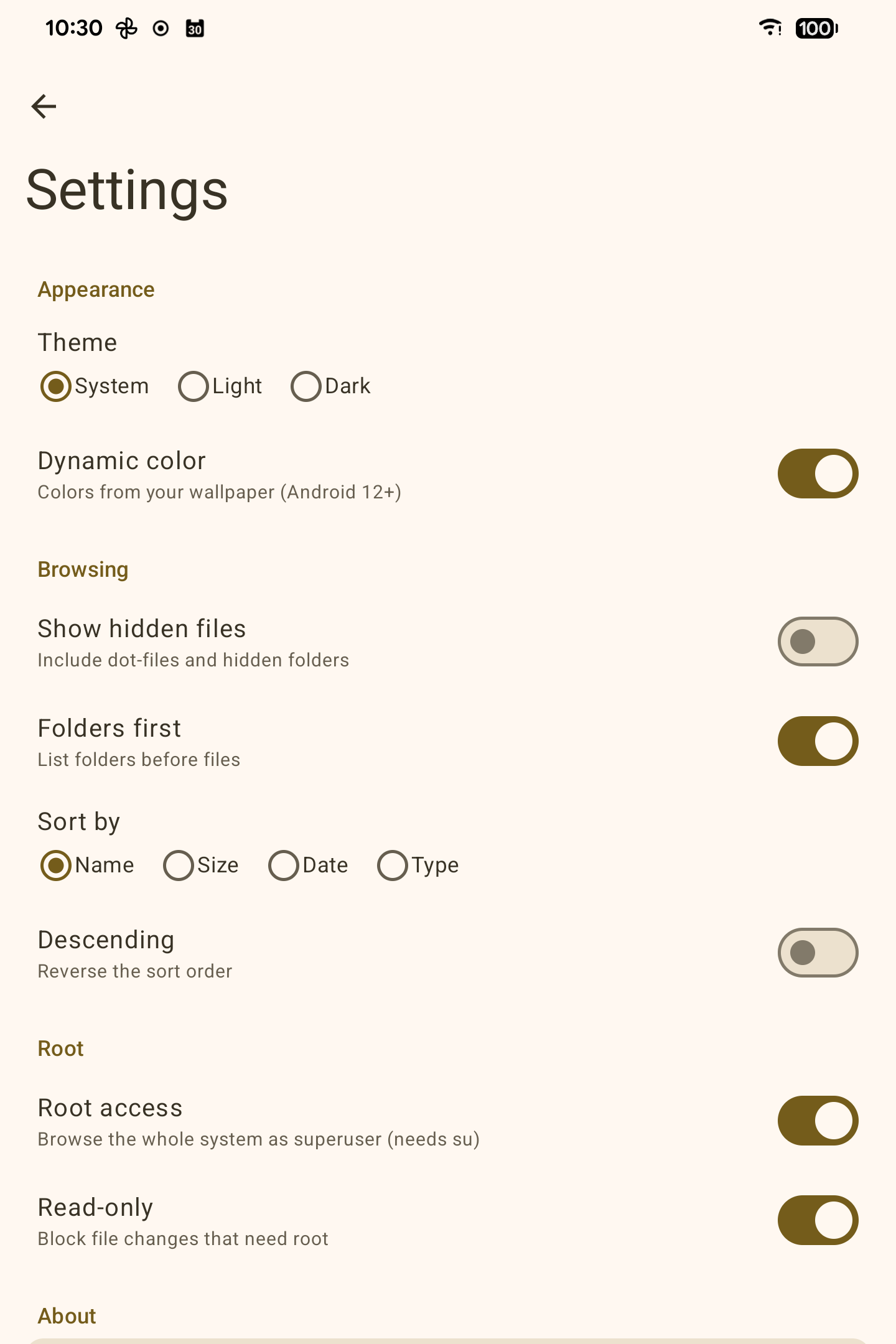
On by default. A Root entry (/) sits with the storage roots — turn Root access
off in Settings to hide it. A separate Read-only switch (also on by default) blocks
anything needing privilege to write, so you can go look without being able to break your
system.
Two interchangeable transports power it, and Settings lets you pick (or leave it on auto):
su— full superuser on rooted devices./dataopens up toadb,anr,app,app-private,dalvik-cache— directories a normal app can't even list — with list/read/write/mkdir/rename/delete under/data,/system, …- Shizuku — no root required: XFiles binds a Shizuku user service running at shell (ADB) privilege that hands over real file descriptors. Settings walks you through setup and permission.
Whichever transport is live also kicks in transparently where plain file access is
denied — most notably Android/data and Android/obb, which open like any
other folder. Thumbnails, viewers and even video playback work on privileged paths.
Opening Root uses su when it is available. Without it, Shizuku can still
list / and browse what the adb shell can see (/system, /proc, /storage,
Android/data). /data and /data/data stay closed until superuser is granted.
The settings screen carries the rest of the preferences too — theme, dynamic color, hidden files, folders-first, sort key and direction.
Viewers
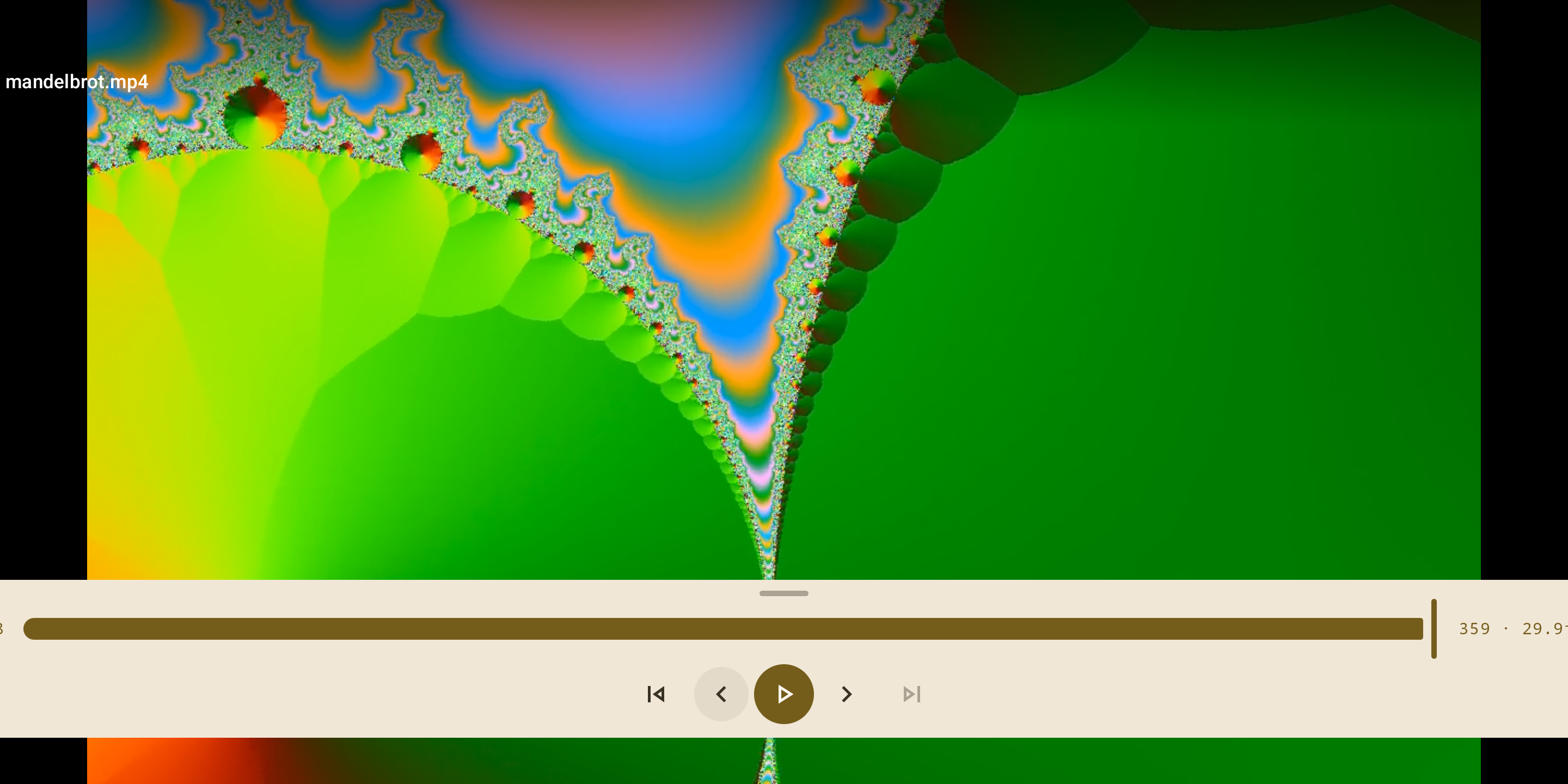
An image viewer (pager + pinch zoom), a text viewer with edit/save, a hex viewer with on-demand paging, an audio player, and a custom video player (Media3/ExoPlayer) with frame-accurate stepping.
Tap the time readout to swap it for a frame counter — current frame, total, and the real frame rate — then step ±1 frame, swipe on the picture to scrub by time or frames with live preview, drag the compact control card out of the way, or go fullscreen immersive.
Search
Live streaming recursive search with */? wildcards. Descends into archives, and
reveals results in the tree on tap.
Open from other apps
Off by default so XFiles never hijacks anything. Three opt-in toggles in Settings register XFiles with the system resolver for archives, images and videos — after that, "open with XFiles" from any app lands in the archive tree or the right viewer.
Material 3 Expressive
MaterialExpressiveTheme + expressive motion, dynamic color (Android 12+),
light/dark/system, floating toolbar, LoadingIndicator / LinearWavyProgressIndicator.
True edge-to-edge: no top app bar — content scrolls under the status bar behind a
gradient scrim, with floating breadcrumb and settings buttons.
18 languages
The UI follows the system language: English plus Arabic, Chinese (Simplified and Traditional), Dutch, French, German, Hindi, Indonesian, Italian, Japanese, Korean, Polish, Portuguese (Brazil), Russian, Spanish, Turkish and Vietnamese.
Permissions & privacy
No network permission, no telemetry, no accounts, no ads. Every permission the app declares, and why:
| Permission | Why |
|---|---|
MANAGE_EXTERNAL_STORAGE |
Browse and modify all of shared storage — the whole point of an X-plore-style manager |
READ_EXTERNAL_STORAGE (≤ API 32) |
Legacy read path on older Android |
WRITE_EXTERNAL_STORAGE (≤ API 29) |
Legacy write path on older Android |
QUERY_ALL_PACKAGES |
The App manager lists what is installed |
REQUEST_DELETE_PACKAGES |
Uninstall from the App manager |
REQUEST_INSTALL_PACKAGES |
The package installer: APKs, split bundles (.apks/.apkm/.xapk), AABs |
POST_NOTIFICATIONS |
Show the progress notification for long operations |
FOREGROUND_SERVICE, FOREGROUND_SERVICE_DATA_SYNC |
Keep a copy/move or install running when backgrounded |
WAKE_LOCK |
Don't sleep mid-operation |
INTERNET |
Not requested. The app cannot talk to the network at all |
That last row is enforced by the OS, not by policy — verify it yourself in
AndroidManifest.xml or with
aapt dump permissions on the APK.
Tech stack
| Layer | Choice |
|---|---|
| Language / UI | Kotlin, Jetpack Compose (BOM 2026.09.00), material3 1.5.0-alpha28 (Expressive APIs) |
| Build | AGP 9.4.1 (built-in Kotlin, no KGP), Gradle 9.7.1, compileSdk 37 / target 37 / min 26 |
| Architecture | MVVM + StateFlow, manual DI composition root (di/Graph); app module + a shaded bundletool vendor module |
| Persistence | DataStore Preferences |
| Media/Images | Coil 3 (GIF, custom fetchers: app icons, disk-cached video thumbnails), Media3 ExoPlayer |
| Archives | java.util.zip, commons-compress (+xz), junrar |
| Privileged access | Shizuku 13.1.5 (user service, real fds) · su shell |
| Package install | PackageInstaller sessions · vendored bundletool 1.18.3 · ARSCLib (in-process aapt2) · minimal self-signed signer |
Note: material3 is pinned to the 1.5 alpha line (1.5.0-alpha28) because the
Expressive APIs are internal in the 1.4.0 stable release.
Project layout
app/src/main/java/app/local1st/files/
├── core/
│   ├── fs/        XEntry model, XId id scheme, XFileSystem + FsRegistry,
│   │   │          Local/Archive/Apps/Root filesystems, storage roots, legacy SAF writes
│   │   └── priv/  privileged transports — su shell & Shizuku user service (real fds)
│   ├── ops/       OperationEngine (copy/move/delete/compress + conflicts), OpsService
│   ├── search/    recursive SearchEngine
│   ├── prefs/     DataStore settings
│   ├── thumb/     Coil fetchers: app icons, disk-cached video thumbnails
│   └── util/      formatters, mime/category mapping, intents; package install —
│                  PackageInstaller sessions, AAB→APKs (bundletool), XAPK/OBB,
│                  in-process aapt2 (ARSCLib), self-signed signing
├── di/            Graph (composition root) + GraphInit wiring
└── ui/
    ├── browser/   PaneController (tree state machine), PaneView, EntryRow
    ├── components/ shared Compose bits (tooltips, predictive back)
    ├── main/      MainViewModel, MainScreen (dual pane + floating toolbar), PermissionGate
    ├── dialogs/   rename/new-folder/delete/zip/details, ops progress + conflicts
    ├── viewer/    image / text / hex viewers, audio player, frame-accurate video player
    ├── search/    search overlay
    ├── settings/  settings screen
    ├── appinfo/   app details overlay
    └── theme/     MaterialExpressiveTheme setup

vendor/bundletool-shaded/   Gradle module shading bundletool 1.18.3 + its pinned deps
Entry ids are URI-like strings: file:///abs/path,
zip:///abs/archive.zip!/inner/path, apps://package.name, root:///abs/path.
Build & run
./gradlew :app:assembleDebug
adb install -r app/build/outputs/apk/debug/app-debug.apk
Requires JDK 17+ and an Android SDK with platform 37. On first launch grant "All files access" (the app deep-links to the system page).
Releases
A GitHub Actions workflow (.github/workflows/release.yml)
builds a signed APK on every push to main on GitHub-hosted Ubuntu runners:
- The build number (
versionCode) increments each run (github.run_number). versionNamelives inversion.properties. While it's unchanged, each push just refreshes a single rollingnightlyprerelease with the latest build. BumpversionNameto cut a new stablevX.Yrelease.- Signing keys/passwords come from repo secrets:
KEYSTORE_BASE64,KEYSTORE_PASSWORD,KEY_ALIAS,KEY_PASSWORD.
License
GPL-3.0-only. A file manager that can be handed root deserves a licence that keeps every future copy open — if you ship a modified XFiles, ship its source too.
This is a study/clone project inspired by X-plore File Manager; it shares no code or assets with the original.
How Shizuku is used
Can browse and edit protected files, toggle app components and preview privileged media via `Shizuku` shell and user service.
This is an AI-assisted analysis of Shizuku-related usages in the app's public source code. It is best effort, so it may not catch every single usage.
How this app uses Shizuku
With Shizuku granted, the file manager uses the Shizuku shell identity and its privileged file service to reach locations the app cannot open directly.
- Browse protected folders: list system areas, filesystem root and hidden app storage folders, with details from
statshell output through Shizuku. - Open and edit files: read file bytes and create new files, folders, renamed items and deleted items using shell operations (
catstreams,mkdir,mv,rm) and direct file descriptors from the privileged service. - Toggle app components: enable or disable activities, services, receivers and providers of other installed apps with the
pm enableandpm disableshell commands through Shizuku. - Preview privileged media: load image thumbnails, video frames and seekable audio or video playback from protected files using file descriptors opened by the privileged service.
- Place game data files: write downloaded OBB style payloads to protected shared storage by creating folders, streaming bytes and fixing permissions with
mkdir,chmodandmvthrough Shizuku.
Android APIs or commands used
ParcelFileDescriptor.openstatcatmkdir -pmv -frm -rfrm -fchmodpm enablepm disablesh -creadlink -fMediaMetadataRetriever.setDataSourceOs.lseek
Notable details
App private data stays unavailable over Shizuku, so internal data entries only appear when a fuller access mode is active. APK installs use the normal system package installer session with user confirmation, which works without Shizuku.
Changelog
What's new for version 1.5.0
XFiles 1.5.0 · build 44 (007807918e6a67e6eb3080fe5a585130d3d9db6e). Offline, open-source file manager — no network, no telemetry.
Changes since v1.4.0
- Write 1.4.0 release notes for Play
- Offer XFiles as a PDF and text viewer from other apps
- Edit a slice of a large text file instead of the whole document
- Keep the play control from flipping while seeking video
- Switch release builds to GitHub-hosted Ubuntu runners
- Show folder item counts that match the visible tree
- Edit text one row at a time with document-range selection
- Bump AGP, Gradle, and Compose to current releases
- Keep lists and pickers above the system bars
- Switch screens with Activity-style predictive back
- Replace several file ranges in one pass, or in place
- Edit large text as loaded stretches, not one window
- Edit empty local files opened from the list
- Honor wrap while editing text
- Keep the keyboard up when the caret changes rows
- Show a saved text file's new size and time in the list
- Show video under the screen switcher on Android 10
- Start screen motions after the revealed page's first frame
- Add a Recycle Bin on each volume
- Keep storage and Root rows out of Rename and Delete
- Keep the space before "and N more" in delete confirmations
- Draw moving screens offscreen when they can't show video
- Let pane headers skip when a folder expands or collapses
- Draw the unselected ring instead of an icon per row
- Ship a Baseline Profile
- Keep the search hint on one line
- Give the viewers light status bar icons in the light theme
- Keep moving screens square when the display reports no corner radius
- Bump versionName to 1.5.0
- Write 1.5.0 release notes for Play
Permissions
13 permissions requested
More from this category
 SD Maid SE
 Material Files
 Buge Files
 KArchiver
 Butler
 ROSE
ROSE
 ZenFile
 File Explorer
 Ripple Files – File Manager
 NFile
NFile
 XClean
 XArchiver