 ShizuStore
OwnDroid
8.3.1 · GitHub
More about this app
Manage your device with Device owner privileges
OwnDroid
Use Android's DevicePolicyManager API to manage your device.
Download
Note
ColorOS users should download testkey version from releases on GitHub
Features
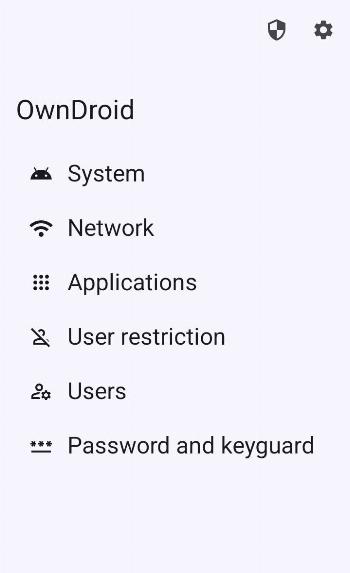
- System: disable camera, disable screenshot, master volume mute, disable USB signal, lock task mode, wipe data...
- Network: add/modify/delete Wi-Fi, network stats, network logging...
- Applications: suspend/hide app, block app uninstallation, grant/revoke permissions, clear app storage, install/uninstall app...
- User restriction: disable SMS, disable outgoing call, disable bluetooth, disable NFC, disable USB file transfer, disable app installing/uninstalling...
- Users: user information, create/start/switch/stop/delete user...
- Password and keyguard: reset password, set screen timeout...
Working modes
Device owner (recommended)
Activating methods:
- Shizuku
- Dhizuku
- Root
- ADB shell command
dpm set-device-owner com.bintianqi.owndroid/.Receiver
Work profile
FAQ
Already some accounts on the device
java.lang.IllegalStateException: Not allowed to set the device owner because there are already some accounts on the device
Solutions: freeze the accounts' holder apps, or delete those accounts.
Already several users on the device
java.lang.IllegalStateException: Not allowed to set the device owner because there are already several users on the device
Solution: Delete secondary users, including work profile, private space and app cloning.
Device owner is already set
java.lang.IllegalStateException: Trying to set the device owner (com.bintianqi.owndroid/.Receiver), but device owner (xxx) is already set.
Only one device owner can exist on a device. Please deactivate the existing device owner first.
MIUI & HyperOS
java.lang.SecurityException: Neither user 2000 nor current process has android.permission.MANAGE_DEVICE_ADMINS.
Solutions:
- Enable
USB debugging (Security setting)in developer options. - Or execute activating command in root shell.
ColorOS
java.lang.IllegalStateException: Unexpected @ProvisioningPreCondition
Solution: Use OwnDroid testkey version
The testkey and signed versions differ only in their signatures. There is no functional difference between them.
Samsung
user limit reached
Samsung restricts Android's multiple users feature. There is currently no solution.
Create work profile / user
On most devices, creating work profile is not allowed by the system when the device owner exist.
Because the system add no_add_managed_profile user restriction when a device owner is set.
Device owner can't modify user restrictions set by the system, but if your device is rooted, you can disable this restriction by executing the following commands in adb shell.
Note: the device owner and the work profile owner can't be the same app, or the device owner will lose its privilege during reboot.
pm set-user-restriction no_add_user 0
pm set-user-restriction no_add_managed_profile 0
pm set-user-restriction no_add_private_profile 0
pm set-user-restriction no_add_clone_profile 0
You should bypass the restrictions at your own risk. It may cause unexpected behavior, for example, the system may delete the user you created silently during reboot.
Some systems disable the feature of adding users in Android settings once a device owner is set. You have to create users in OwnDroid. Or if you have root, run the above command in adb shell to remove that restriction.
For advanced users
API
OwnDroid provides an Intent-based API. You need to set the API key in settings and enable the API. The numbers in brackets represent the minimum Android version required.
- HIDE(package: String)
- UNHIDE(package: String)
- SUSPEND(package: String) (7)
- UNSUSPEND(package: String) (7)
- DISABLE_METERED_DATA(package: String) (9)
- ENABLE_METERED_DATA(package: String) (9)
- DISABLE_USER_CONTROL(package: String) (11)
- ENABLE_USER_CONTROL(package: String) (11)
- BLOCK_UNINSTALL(package: String)
- UNBLOCK_UNINSTALL(package: String)
- CLEAR_APP_STORAGE(package: String) () (9)
- ADD_USER_RESTRICTION(restriction: Boolean)
- CLEAR_USER_RESTRICTION(restriction: Boolean)
- SET_PERMISSION_DEFAULT(package: String, permission: String) (6)
- SET_PERMISSION_GRANTED(package: String, permission: String) (6)
- SET_PERMISSION_DENIED(package: String, permission: String) (6)
- SET_SCREEN_CAPTURE_DISABLED()
- SET_SCREEN_CAPTURE_ENABLED()
- SET_CAMERA_DISABLED()
- SET_CAMERA_ENABLED()
- SET_USB_DISABLED() (12)
- SET_USB_ENABLED() (12)
- LOCK()
- REBOOT() (7)
# An example of hiding app in ADB shell
am broadcast -a com.bintianqi.owndroid.action.HIDE -n com.bintianqi.owndroid/.ApiReceiver --es key abcdefg --es package com.example.app
// An example of hiding app in Kotlin
val intent = Intent("com.bintianqi.owndroid.action.HIDE")
    .setComponent(ComponentName("com.bintianqi.owndroid", "com.bintianqi.owndroid.ApiReceiver"))
    .putExtra("key", "abcdefg")
    .putExtra("package", "com.example.app")
context.sendBroadcast(intent)
Build
You can use Gradle in command line to build OwnDroid.
# Use testkey for signing (default)
./gradlew build
# Use your custom .jks key for signing
./gradlew build -PStoreFile="/path/to/your/jks/file" -PStorePassword="YOUR_KEYSTORE_PASSWORD" -PKeyPassword="YOUR_KEY_PASSWORD" -PKeyAlias="YOUR_KEY_ALIAS"
(Use ./gradlew.bat instead on Windows)
Contribute
Contributions are welcome!
- Fork this repository (deselect "Copy the master branch only", which is selected by default)
- Clone your own repository using git (please use the
devbranch) - Make changes (AI-assisted changes is allowed, but you have to ensure the quality)
- Run the app on your device or emulator to test your changes (required for code contributions, optional for translation contributions)
- Commit and push changes
- Open a pull request in this repository
License
Copyright (C) 2026 BinTianqi
This program is free software: you can redistribute it and/or modify it under the terms of the GNU General Public License as published by the Free Software Foundation, either version 3 of the License, or (at your option) any later version.
This program is distributed in the hope that it will be useful, but WITHOUT ANY WARRANTY; without even the implied warranty of MERCHANTABILITY or FITNESS FOR A PARTICULAR PURPOSE. See the GNU General Public License for more details.
You should have received a copy of the GNU General Public License along with this program. If not, see https://www.gnu.org/licenses/.
How Shizuku is used
Can activate device owner and organization profile ownership via `dpm` shell commands through Shizuku.
This is an AI-assisted analysis of Shizuku-related usages in the app's public source code. It is best effort, so it may not catch every single usage.
How this app uses Shizuku
OwnDroid uses Shizuku only during initial activation to run privileged device management commands without manual ADB input.
- Activate device owner: from the working modes activation dialog the user can choose Shizuku to set OwnDroid as device owner with the
dpm set-device-ownershell command through Shizuku. - Activate organization profile: the user can choose Shizuku to mark OwnDroid as profile owner on an organization owned device with the
dpm mark-profile-owner-on-organization-owned-deviceshell command through Shizuku.
Android APIs or commands used
dpm set-device-ownerdpm mark-profile-owner-on-organization-owned-device
Notable details
The same activation commands are also shown in the app for manual entry over ADB, so Shizuku is offered as a one tap alternative to typing the command elsewhere.
Changelog
What's new for version 8.3.1
This is a patch version for v8.3, which fixed a lifecycle issue of ViewModel. The complete changelog between v8.2 and v8.3 can be found here
Permissions
15 permissions requested
Sources
2 sources
Sources
2 sources
More from this category
 Dhizuku
 Harbor
 Déchaîner
 MDPC
MDPC