 ShizuStore
Nothing Modes
0.19.7 · GitHub
More about this app
Automation app for Nothing phones (modes, routines, Glyph) that also runs on other Android devices with optional Shizuku
Nothing Modes
Open-source Android automation for Nothing phones — and every other Android device.
Built like a premium system app: OLED-black surfaces, monoline iconography, dot-matrix hero type, and a single red accent. The engine is pure Kotlin; the UI is Jetpack Compose. Shizuku and Nothing Glyph are supported, not required.


What it does
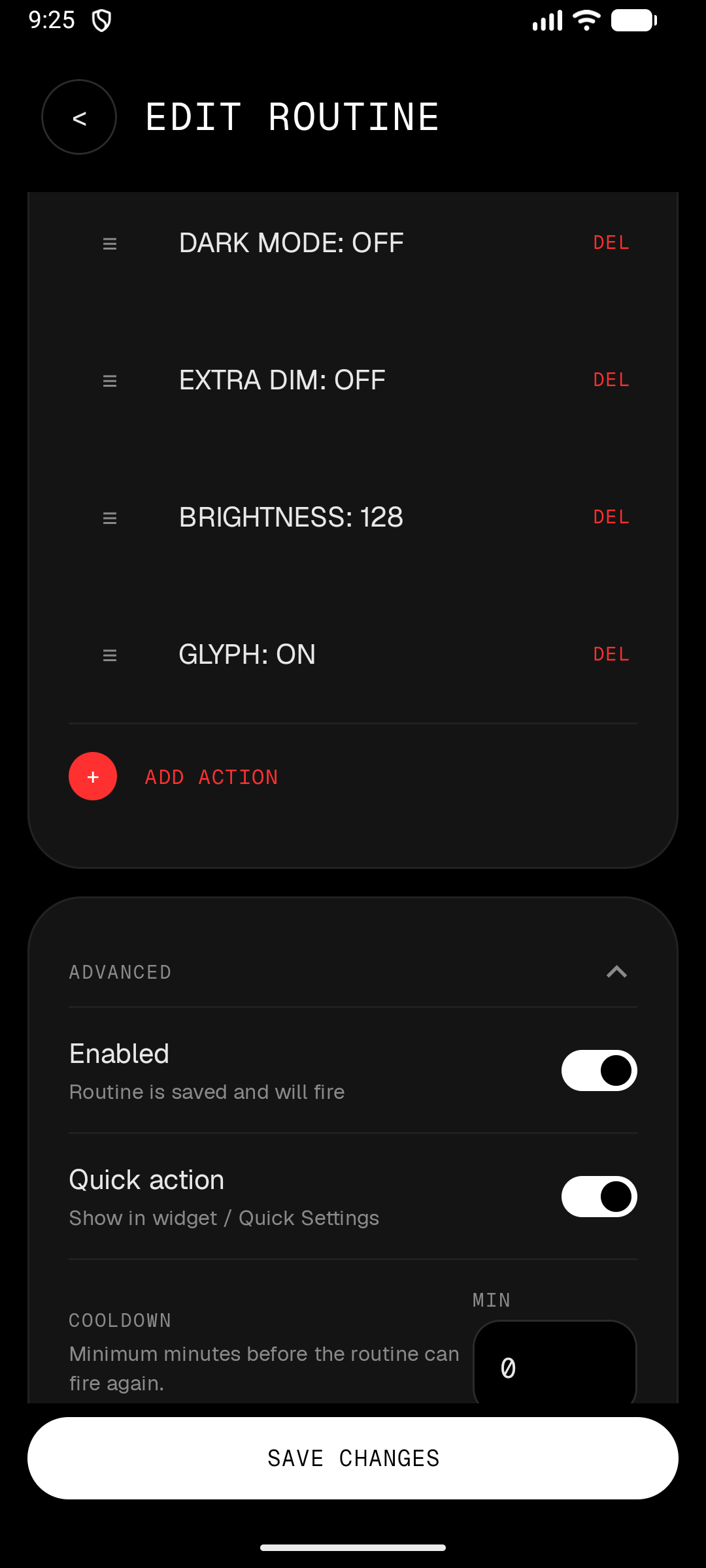
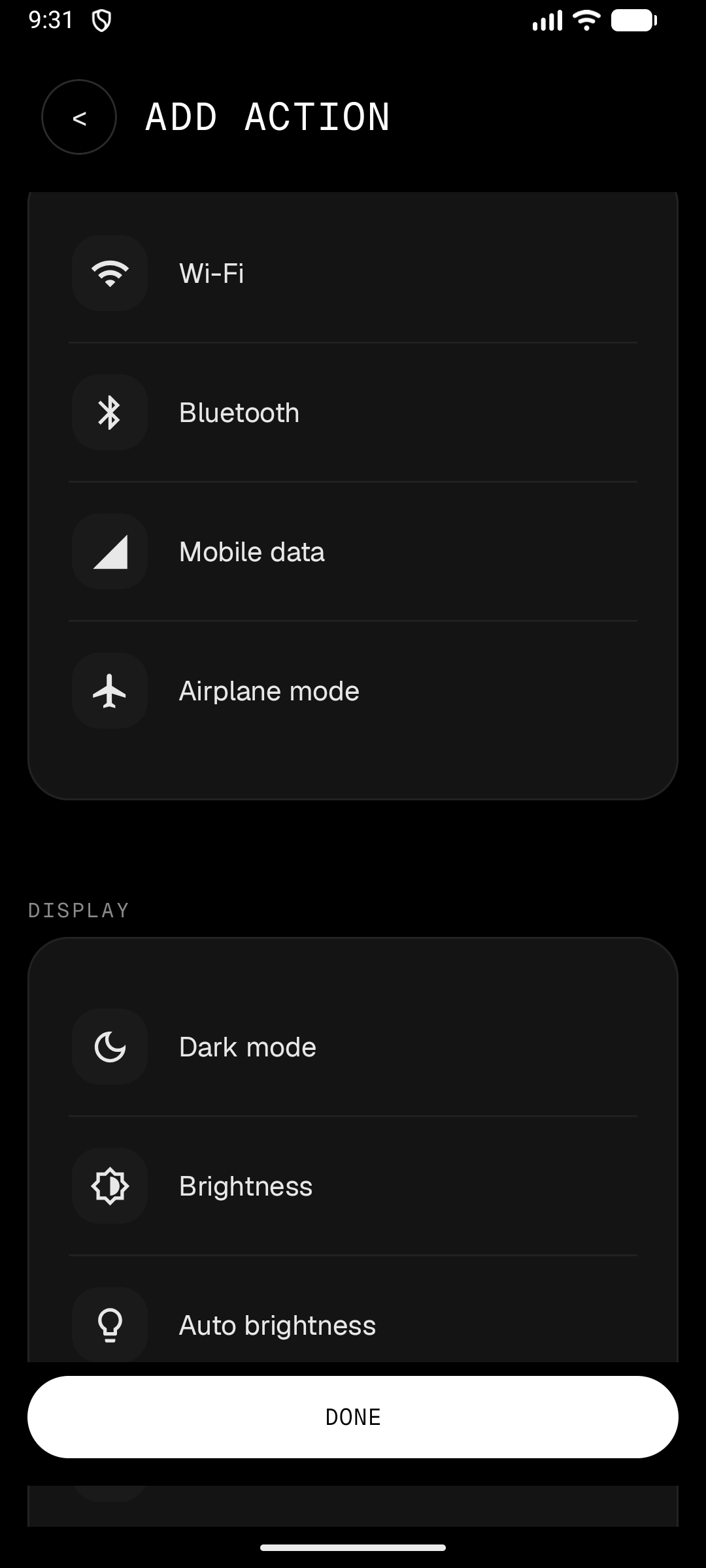
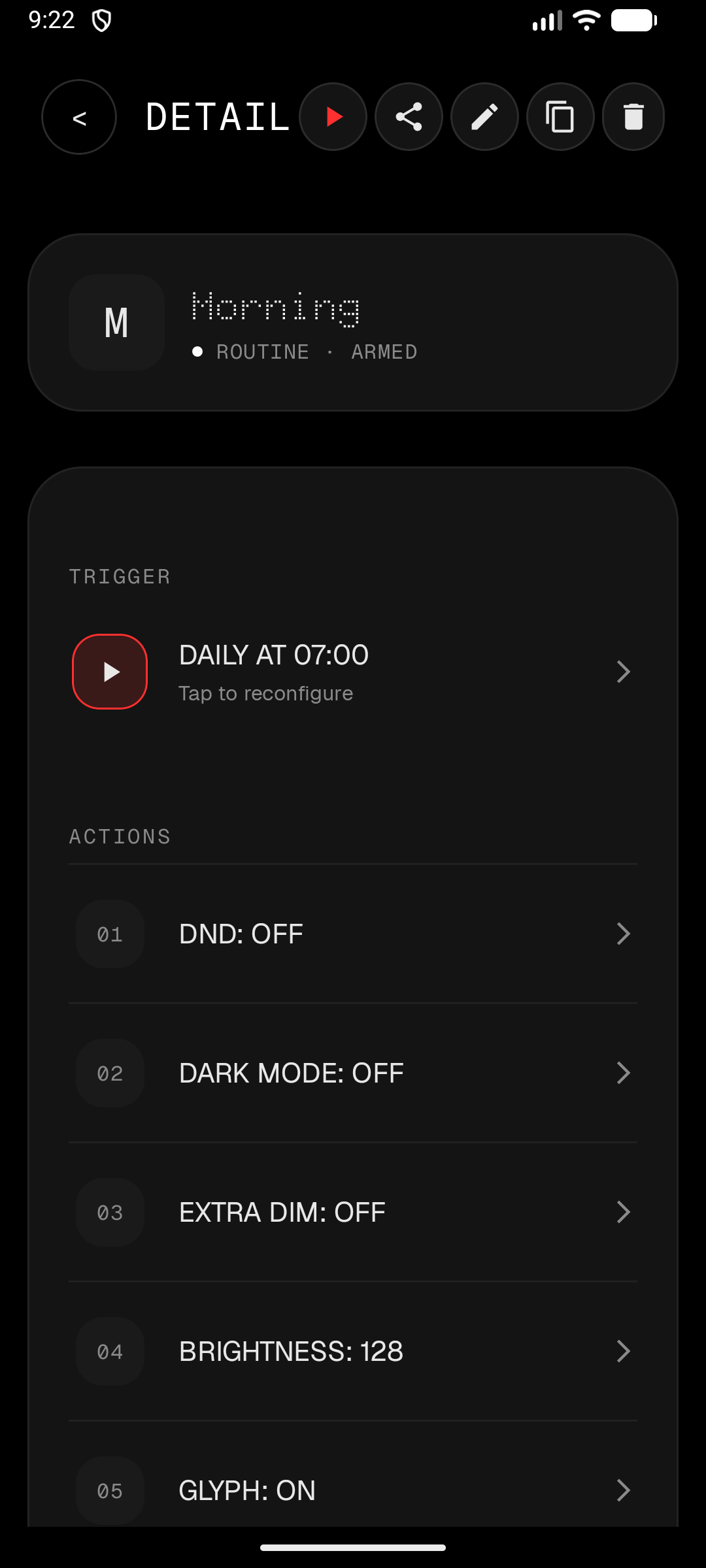
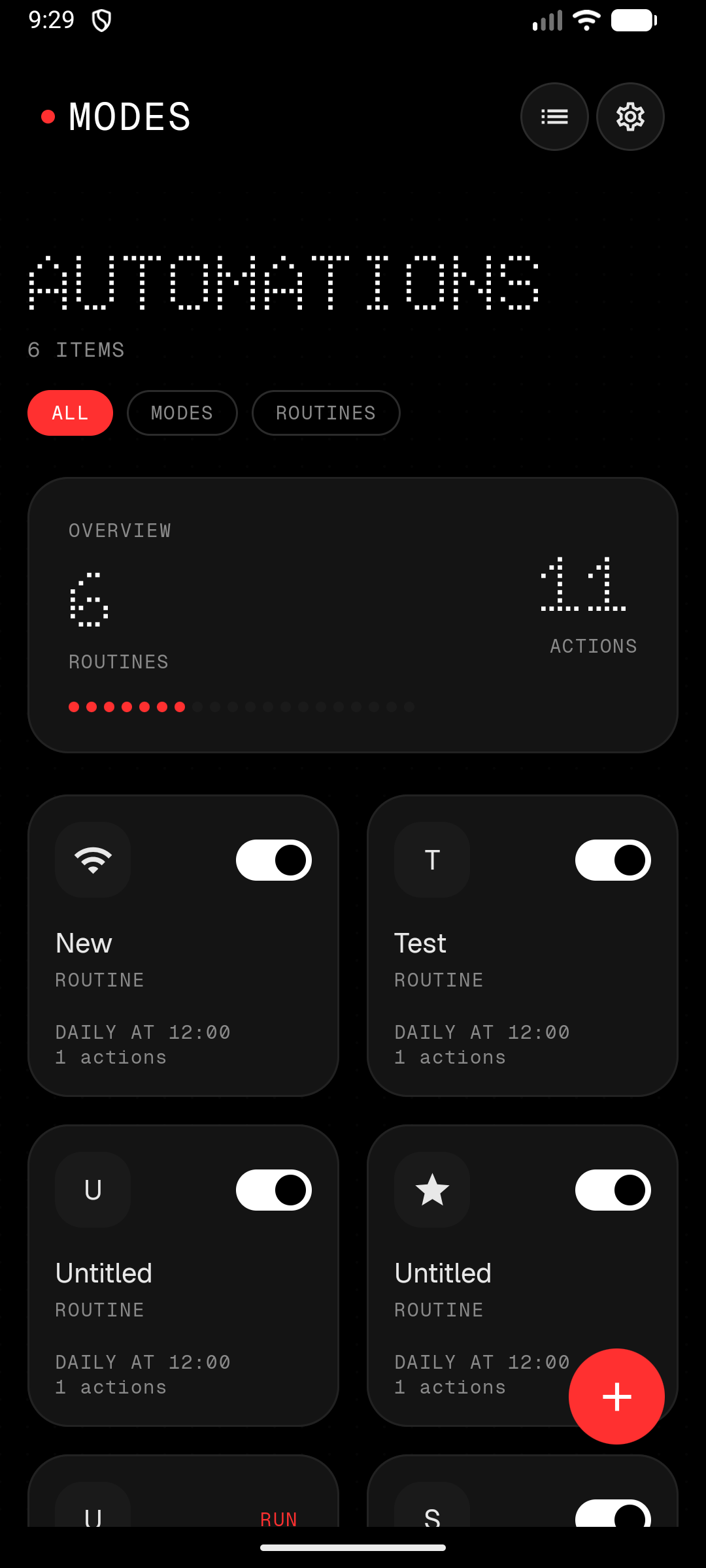
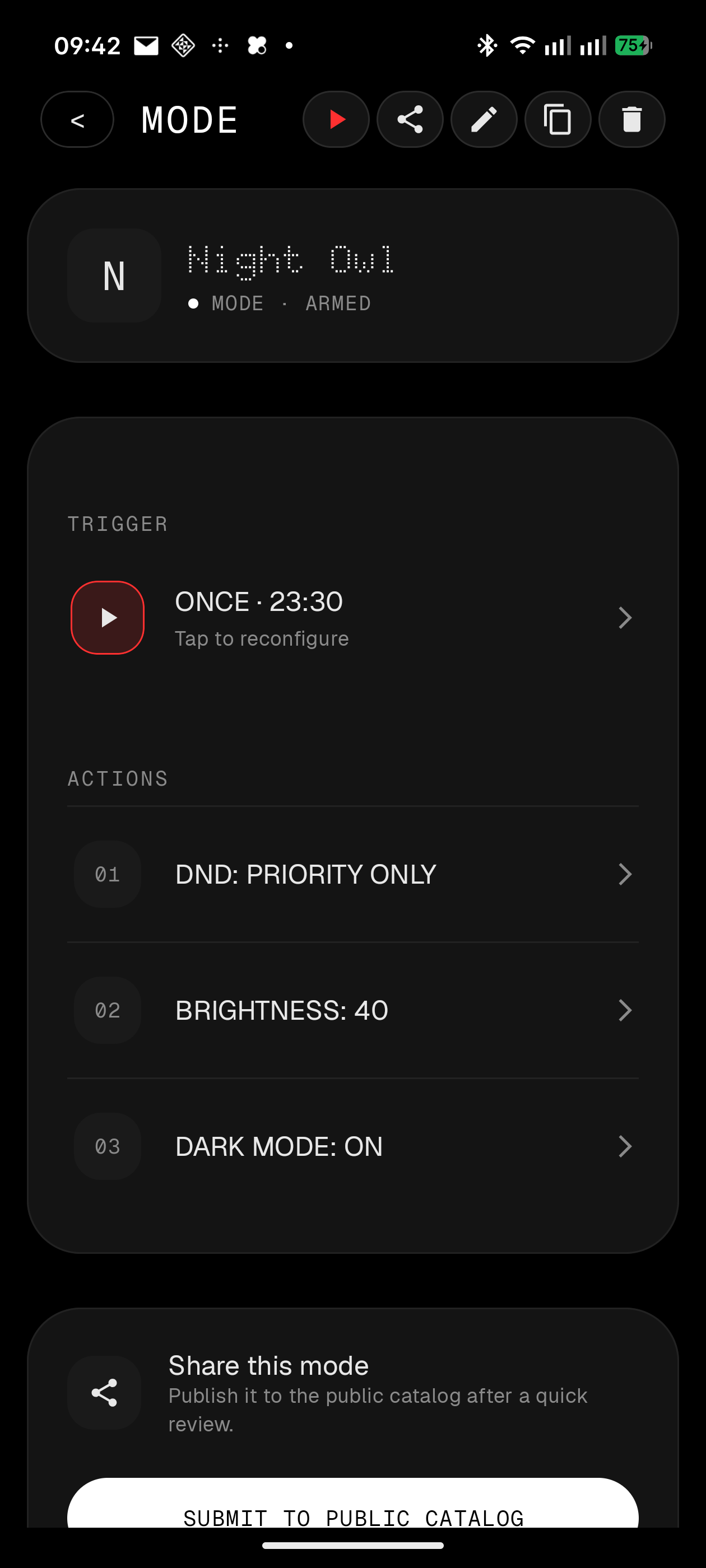
- Modes — persistent or event-based automations (Sleep, Work, Gaming, or event triggers) with optional conditions, actions, and automatic state restoration.
- WHEN / ONLY IF / THEN builder — explicit, no confusion about what runs when.
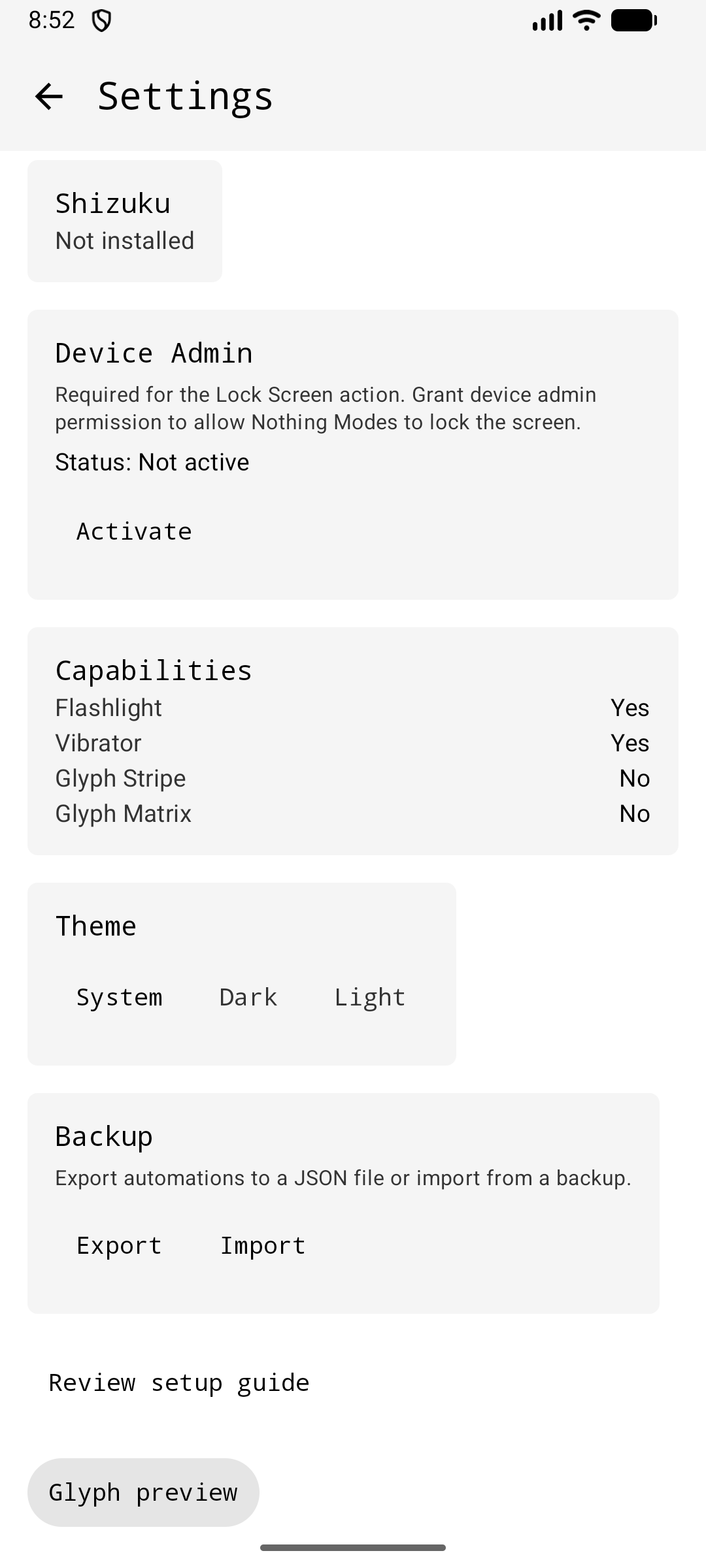
- Nothing Glyph / Glyph Matrix — light stripe and matrix on supported devices.
- Shizuku — optional, graceful degradation everywhere else.
- Capability detection — the app asks what the device can do instead of guessing.
- Priority + cooldown + conflict resolution — deterministic ordering, overlap suppression, and fire cooldown.
- Import / export / share — JSON bundles with schema versioning.
- Privacy-first diagnostics — no analytics SDKs; crash reports are opt-in, and after a crash the app shows the error and asks before anything is sent.
Glyph support
| Device | Glyph Stripe | Glyph Matrix | Glyph Toy |
|---|---|---|---|
| Nothing Phone (1) | Yes | No | No |
| Nothing Phone (2) | Yes | No | No |
| Nothing Phone (2a) / (2a)+ | Yes | No | No |
| Nothing Phone (3a) / (3a) Pro | Yes | No | No |
| Nothing Phone (3) | Yes | Yes (25x25) | Yes |
| Nothing Phone (4a) | Yes | No | No |
| Nothing Phone (4a) Pro | Yes | Yes (13x13) | Yes |
| Nothing Phone (4b) | Yes | No | No |
| Non-Nothing devices | No | No | No |
How Glyph output works — read this first
Nothing OS hands the Glyph interface to one selected toy at a time. Whoever owns the current Glyph Toy slot (or the Always-on toy slot) is the only app whose frames reach the lights. There is no API to switch that selection programmatically — Nothing controls it.
What this means in practice:
- To see Nothing Modes output, select Nothing Modes in Settings → Glyph Interface → Glyph Toys (or as the Always-on toy). The Glyph Preview screen in the app has shortcut buttons to both pickers and shows a live "Matrix owner" status.
- We cannot trigger other apps' Glyph Toys. Toy apps can be bound and sent lifecycle messages, but their frames never reach the lights while another toy owns the slot — we verified this on-device. Nothing Modes renders its own equivalents (battery ring, progress, text, marquee, icons) instead.
- If another toy is selected, Glyph actions fail honestly with "matrix owned by another toy" instead of pretending to render. Check the "Matrix owner" row in Settings → Glyph Preview — it always shows who currently controls the lights.
This exclusivity is Nothing's platform rule, not a limitation we chose. If Nothing ever exposes a public toy-switching API, we will use it.
Build
./gradlew assembleDebug
./gradlew :engine-core:test
./gradlew :ui:lintDebug
Requires JDK 17+ and Android SDK API 36.
Architecture
app
├── ui                 — Compose screens, theme, design primitives
├── automation-android — services, receivers, scheduler
│   ├── engine-core    — pure Kotlin engine
│   ├── data           — Room stores
│   ├── capabilities   — action executors, capability resolver
│   ├── core-shizuku   — Shizuku gateway
│   ├── device-tools   — shell-based state readers
│   └── nothing-integrations — Glyph SDK wrapper
The engine resolves each action through: Public Android API → Nothing API → Shizuku → settings panel fallback.
Modules
| Module | Role |
|---|---|
engine-core |
Pure Kotlin automation engine |
device-tools |
Shell-based device state readers |
automation-android |
Android lifecycle, services, receivers |
ui |
Jetpack Compose screens and design system |
core-shizuku |
Shizuku privileged shell transport |
capabilities |
Action executors and resolver |
nothing-integrations |
Nothing Glyph SDK wrapper |
data |
Room persistence |
app |
Entry point and nav host |
Quick start
- Install on Android 9+.
- Follow the in-app onboarding for restricted settings and optional Shizuku.
- Create a mode from the builder, a template, or a shared JSON link.
- Automations fire on triggers, check conditions, then execute actions in order.
Templates and sharing
Community templates live in templates/ — browse them in-app via the grid icon on the Modes screen. To contribute one, see templates/README.md.
Share any mode from the detail screen as a JSON bundle. Bundles carry schemaVersion, appVersion, and requiredCapabilities, so imports across users and app versions show compatibility warnings before anything is written.
Shizuku
Optional. Without it, every action still resolves — silent where the platform allows, a jump to the right settings panel where it doesn't. Shizuku turns the panel fallback into a silent toggle.
Verified on Nothing Phone 3, Nothing OS 4.1, Android 16:
| Action | Without Shizuku | With Shizuku |
|---|---|---|
| Wi-Fi, mobile data, hotspot | connectivity panel | silent toggle |
| Airplane mode | airplane settings | silent toggle (cmd connectivity) |
| Battery saver, data saver, auto-sync | settings panel | silent toggle |
| Always-On Display, extra dim | display settings | silent toggle |
| Location mode, refresh rate | settings panel | silent toggle (secure table) |
Arbitrary WriteSetting |
permission-required | silent toggle |
| NFC | NFC panel | NFC panel — svc nfc is killed on Nothing OS 4.1 even for shell; platform limitation |
| Screenshot | per-capture consent (MediaProjection) | same |
| Everything else — Glyph, volume, ringer, DND, brightness, dark mode, rotation, flashlight, notifications, media, clipboard, app/URL launch, lock screen, SMS | runtime permissions only | unchanged |
Get Shizuku from GitHub or the Play Store, then grant it inside the app's settings sheet.
Testing
./gradlew :engine-core:test
./gradlew connectedCheck
Documentation
License
GPL-3.0
Authored By: TDvorak [email protected]
How Shizuku is used
Can toggle radios, system settings, privacy sensors, Glyph switch, refresh rate and screenshots via Shizuku shell with `svc`, `settings put`, `cmd` and `screencap`.
This is an AI-assisted analysis of Shizuku-related usages in the app's public source code. It is best effort, so it may not catch every single usage.
How this app uses Shizuku
Shizuku provides a privileged shell that lets automation modes and routines change protected system state directly on the device.
- Toggle WiFi and Bluetooth: turn WiFi and Bluetooth on or off in modes and routines with the
svc wifiandsvc bluetoothshell commands through Shizuku. - Toggle mobile data and NFC: switch mobile data and NFC from automations with the
svc dataandsvc nfcshell commands through Shizuku. - Switch airplane mode: enable or disable airplane mode in routines with the
cmd connectivity airplane-modecommand through Shizuku. - Control power savers: turn battery saver, data saver, hotspot, auto sync and stay awake while charging on or off with
settings putwrites to global settings through Shizuku. - Edit any system setting: write a chosen system, secure or global setting key and value with the
settings putcommand through Shizuku, used for custom setting actions. - Adjust display and privacy: change refresh rate, always on display, extra dim, font scale, Night Light, color inversion, color correction, one handed mode and location mode with
settings putwrites through Shizuku. - Block mic and camera: mute or unmute microphone and camera sensors in modes with the
cmd sensor_privacycommand through Shizuku. - Control Glyph lights: turn the Nothing Glyph interface master switch on or off device wide with a global
settings putwrite through Shizuku. - Take screenshots: capture the screen for screenshot actions with the
screencapcommand through Shizuku.
Android APIs or commands used
svc wifi enable/disablesvc bluetooth enable/disablesvc data enable/disablesvc nfc enable/disablesettings putcmd connectivity airplane-modecmd sensor_privacysh -cscreencap -p
Notable details
Many toggles try a normal Android API first and open the matching system settings page when Shizuku is unavailable, so the action can be finished manually. Custom setting writes accept any system, secure or global key that passes shape checks, with no fixed allowlist.
Changelog
What's new for version 0.19.7
What's Changed
- feat(geofence): deactivation policies, position gate, background-location fix by @Dvorinka in https://github.com/Dvorinka/Nothing_Modes/pull/28
Full Changelog: https://github.com/Dvorinka/Nothing_Modes/compare/v0.19.6...v0.19.7



Permissions
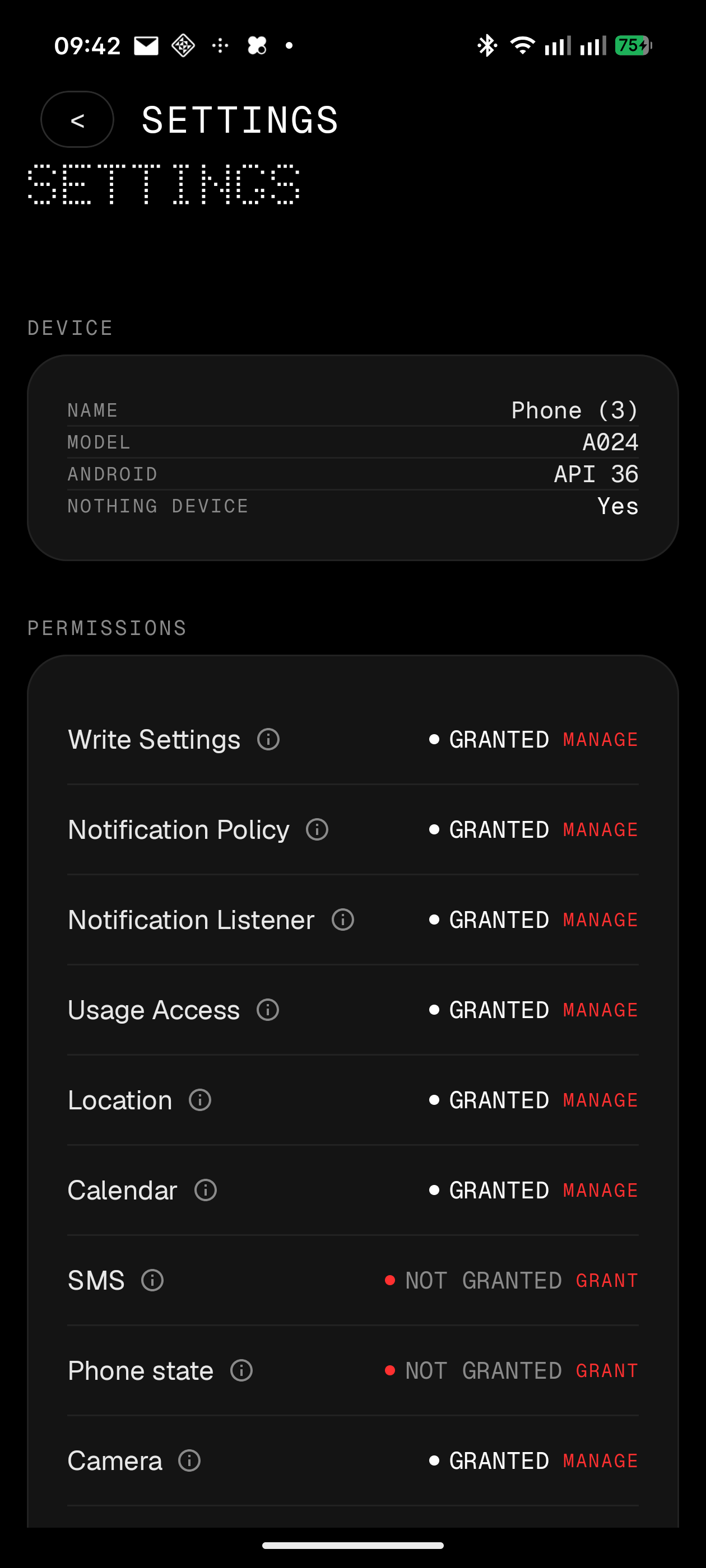
39 permissions requested
More from this category
 IMD
IMD
 Argus
Argus
 FlowPilot
 OpenTasker
 NexaFlow
 Service Keeper
 AutoJs6
 vFlow
vFlow
 PhoneProfilesPlus
 自动滑动器
自动滑动器
 Tasker Settings
 MacroDroid