 ShizuStore
Aurora Droid
2.0.1 · GitLab
More about this app
FOSS F-Droid client with silent installs via Shizuku/root and automatic updates


Aurora Droid
Aurora Droid is another FOSS client for F-Droid.
It works with the same repositories as the official client and presents them through a Material 3 interface. Enable as many repositories as you like, and everything available to you appears in a single searchable catalogue. Downloads are handled by a proper download manager, installs can run silently through root or Shizuku, and updates can be checked and applied on their own.
Version 2.x is a full rewrite: new interface, new database, and new sync, download and install paths. Nothing carries over from 1.x, so repositories, favourites and blacklists have to be set up again.
Aurora Droid is not affiliated with or endorsed by F-Droid.

Nightly builds are at AuroraOSS and in the Telegram group.
Screenshots


Features
One catalogue across every repository. Apps from all enabled repositories appear in a single list, organised by category, with recently added and recently updated sections. Search covers all of them at once.
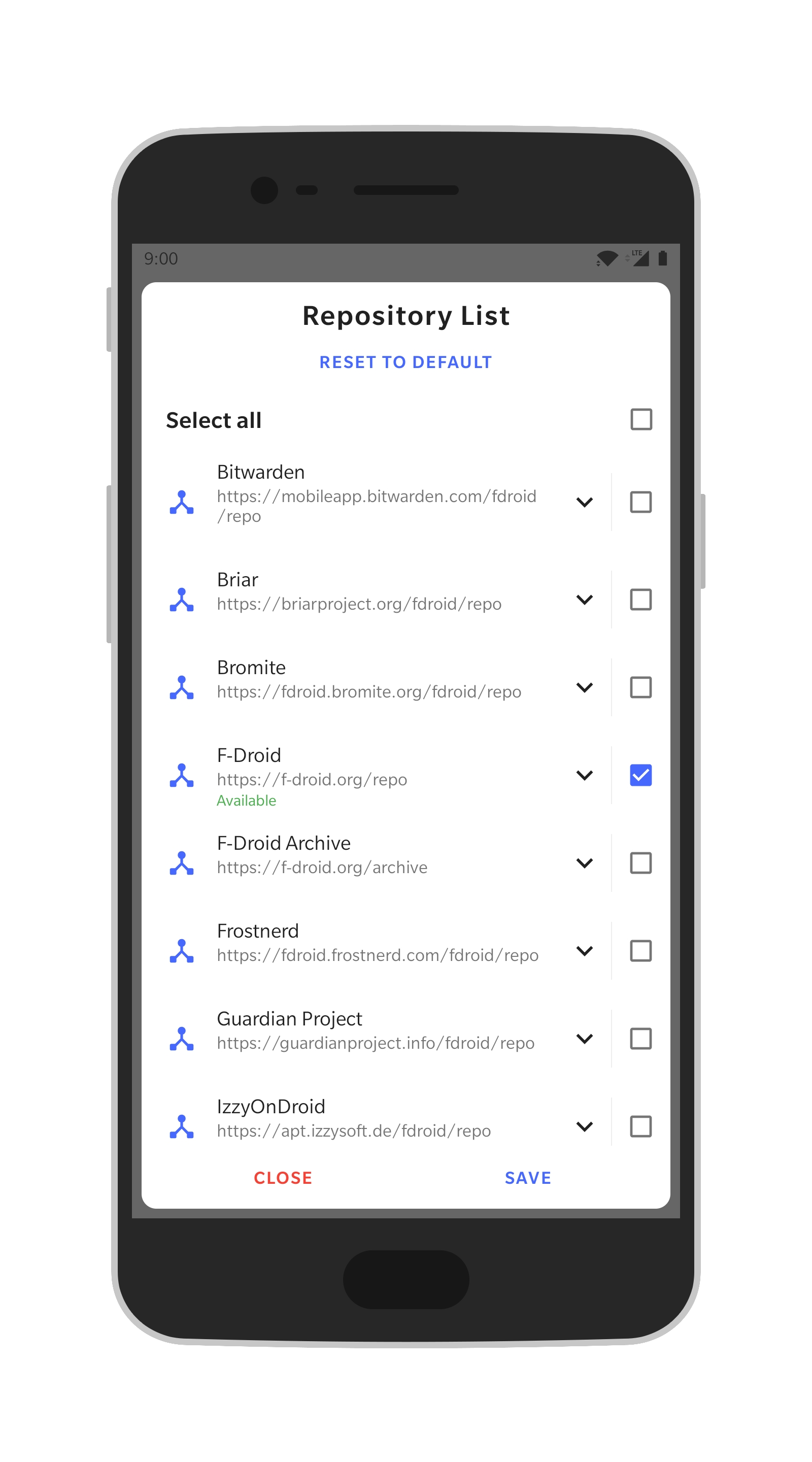
Repository management. Add any F-Droid repository by pasting its link, then enable, disable, reorder or remove it at any time. Where two repositories carry the same app, the one placed higher in the list takes precedence. F-Droid is enabled by default; IzzyOnDroid and microG are included but switched off.
Four install methods. The default session installer, the system installer, root, and Shizuku. Root and Shizuku install without a confirmation dialog for each app.
Scheduled update checks. Repositories are checked on an interval of your choosing, from every 6 hours to weekly, or not at all. On devices that support silent installs, updates can be downloaded and applied automatically. All background activity can be restricted to Wi-Fi.
Compatible updates only. Versions built for a different CPU architecture, or requiring a newer Android release than the device runs, are not offered as updates.
A full download manager. Progress, cancellation, retries and queue management, with automatic fallback to a repository's mirrors when its primary server is unavailable.
Grouped notifications. A batch of updates produces a single summary rather than one notification per app.
Favourites, blacklist and ignored updates. Mark the apps you follow, hide packages you never want to see, and skip a specific version of an individual app.
No tracking. No analytics, no accounts, no third-party services. Every APK is verified against the checksum published by its repository before installation, and repositories are pinned to their signing key, so a substituted server cannot serve different content.
Free software. GPLv3, developed in the open, with no proprietary components in the build.
Requirements
| Requirement | Version |
|---|---|
| Android | 7.0 (API 24) and above |
| Target/compile SDK | 37 |
| JDK | 21 (the Gradle toolchain resolves it automatically) |
| Gradle | via ./gradlew, AGP 9.x, Kotlin 2.4.x |
Building
git clone https://gitlab.com/AuroraOSS/auroradroid.git
cd auroradroid
./gradlew assembleDebug
The APK lands in app/build/outputs/apk/ as AuroraDroid-<version><-type><-unsigned>.apk.
Build types
| Type | Application ID | Notes |
|---|---|---|
debug |
com.aurora.adroid.debug |
Signed with the tracked AOSP testkey.jks, so debug builds are interchangeable across machines |
release |
com.aurora.adroid |
Minified and resource-shrunk |
nightly |
com.aurora.adroid.nightly |
Release settings, version name suffixed with the short commit hash |
Release and nightly builds are signed only if a signing.properties exists in the project root;
without it they are produced unsigned and the file name says so. The file is gitignored and looks
like this:
STORE_FILE=/path/to/keystore.jks
STORE_PASSWORD=...
KEY_ALIAS=...
KEY_PASSWORD=...
Checks
./gradlew ktlintCheck    # style, `ktlintFormat` to fix
./gradlew lintDebug      # Android lint, config in app/lint.xml
Room schemas are exported to app/schemas/; commit the new JSON whenever the database version
changes.
Project layout
Everything lives in the single :app module, under com.aurora.adroid.
| Package | What is in it |
|---|---|
compose/ui/ |
One package per screen (apps, categories, updates, details, downloads, repositories, search, settings, about, installed, favourites, blacklist, ignored) |
compose/composable/ |
Shared widgets: list items, top bars, placeholders, shimmer, permission lists |
compose/navigation/ |
Screen keys and the Navigation 3 NavDisplay |
compose/theme/ |
Material 3 expressive theme, dynamic colour, light/dark |
viewmodel/ |
One ViewModel per screen, Paging 3 where lists can grow |
data/sync/ |
Repository index: download, fingerprint verification, streaming parse, v2 diff merge, persistence |
data/network/ |
OkHttp client, conditional index downloads, byte-range aware downloader, proxy support |
data/download/ |
Mirror resolution and APK hash verification |
data/installer/ |
Session, native, root and Shizuku installers behind one IInstaller |
data/work/ |
SyncWorker, DownloadWorker, InstallWorker, UpdateWorker |
data/room/ |
Database, DAOs and entities (repo, app, version, installed, download, favourite, blacklist, ignored, anti-feature) |
data/repository/ |
Query surface the ViewModels talk to |
data/helper/ |
Sync, download and install orchestration, update batching |
data/receiver/ |
Install status, package add/remove, download cancel and retry |
util/, extensions/ |
Preferences (DataStore), notifications, paths, shortcuts, small Kotlin/Android extensions |
How a sync works
SyncWorkerruns per repository, either on demand or from a scheduledUpdateWorkersweep.RepoSyncertriesEntrySyncablefirst. It fetchesentry.jarconditionally, so an unchanged repository costs one 304 response. Where the entry offers a diff against the timestamp already held, only the diff is fetched and merged as an RFC 7386 JSON merge patch.- A 404 on
entry.jarfalls back toV1Syncableandindex-v1.jar, which is converted to the v2 shape in memory. - The JAR's signing certificate is hashed and matched against the repository fingerprint. A repository added without a fingerprint pins the one it presents on first sync; a mismatch after that fails the sync.
IndexPersisterstreams the index into Room in a single transaction, so a failure part-way leaves the previous catalogue intact.
How an install works
DownloadWorker resolves the APK URL (falling back through the repository's mirrors), downloads it
to filesDir/apk/, and verifies the SHA-256 from the index. InstallWorker then hands the file to
the selected installer. Downloaded APKs are removed once the package manager confirms the install.
How to
Add a repository. More → Repositories → the add button. Paste either a plain URL or a full
F-Droid link carrying the fingerprint, for example
https://example.org/fdroid/repo?fingerprint=ABCD.... fdroidrepo:// and fdroidrepos:// links
are accepted too. Without a fingerprint the first sync pins whatever the repository presents, which
is trust-on-first-use, so prefer the fingerprint form when you have it.
Aurora Droid ships with F-Droid enabled, and IzzyOnDroid and microG present but disabled.
Reorder repositories. Drag them in the repositories list. The one nearer the top wins when the same package is published by more than one repo.
Install without confirming every app. Settings → App installer, then pick Root or Shizuku. Session and System both go through Android's own confirmation dialog and cannot be silent. Shizuku takes a little setup, covered below.
Turn on automatic updates. Settings → Updates → Install updates automatically. It stays paused unless background checks are on and the selected installer can install without confirmation, and the screen tells you which of the two is missing.
Change how often updates are checked. Settings → Updates → Update checks: never, every 6 hours, every 12 hours, daily or weekly. "Check on Wi-Fi only" makes background checks and automatic downloads wait for an unmetered network.
Use a proxy. Settings → Network → Proxy, as protocol://host:port with an optional
user:password@. http, https, socks and socks5 are supported, and it takes effect on the
next connection.
Stop an app from nagging. Open the app and ignore the update to skip that one version, or use the blacklist to hide the package entirely. Both lists are under More.
Setting up the Shizuku installer
Shizuku lends Aurora Droid the system privileges it needs to install apps without a confirmation dialog, on a device with no root. It is what makes fully automatic updates possible on a stock phone.
You need Android 8.0 or later.
1. Install and start Shizuku.
Get it from F-Droid or the project site, open it, and start the service by whichever route your device allows:
- Wireless debugging (Android 11 and later, no computer needed) - turn on Developer options, enable Wireless debugging, and follow the pairing steps Shizuku walks you through.
- ADB from a computer - enable USB debugging, plug in, and run the command Shizuku shows you.
- Root - tap Start, grant superuser access, and you are done. If you are rooted, installing Sui instead is smoother; Aurora Droid treats it exactly like Shizuku.
Started over ADB or wireless debugging, Shizuku stops at every reboot and has to be started again. Started with root or Sui, it comes back on its own.
2. Point Aurora Droid at it.
Settings → App installer → Shizuku installer.
3. Grant the permission.
The first install asks Shizuku for access; allow it. If you miss the prompt, or something is off later, Aurora Droid tells you which piece is missing rather than failing quietly.
4. Optional: let updates install themselves.
With Shizuku working, Settings → Updates → Install updates automatically stops being greyed out. Pair it with an update check interval and new versions download and install in the background.
If installs start failing, the usual cause is Shizuku having stopped after a reboot. Open it and start the service again.
Translations
Aurora Droid is translated on Weblate: hosted.weblate.org/translate/aurora-droid.

Adding a language or correcting a string needs no Git knowledge and no local setup; sign in and
start typing. Source strings live in app/src/main/res/values/strings.xml and are the only ones
edited by hand. Translated resources come back from Weblate, so please do not submit them as merge
requests.
Credits
Aurora Droid reuses code from these projects, all GPL-3.0-or-later. Individual files carry the attribution in their header.
- Aurora Store - installers (session, native, root, Shizuku), the download worker and download UI, notifications, navigation scaffolding, the settings screens and a number of shared composables.
- Droid-ify - the repository sync path: index entry and v1 handling, JAR fingerprint verification, and the OkHttp download layer.
- Neo Store - applying index-v2 diffs as RFC 7386 JSON merge patches.
- F-Droid - the repositories, the index format and the specification everything above implements.
Libraries
Jetpack Compose · Material 3 · Navigation 3 · Room · Hilt · WorkManager · Paging 3 · DataStore · kotlinx.serialization · Coil · OkHttp · libsu · Shizuku · Refine · HiddenApiBypass
Support development


Links
License
GPL-3.0-or-later. See LICENSE.
How Shizuku is used
Can silently install apps via `IPackageInstaller` sessions through Shizuku
This is an AI-assisted analysis of Shizuku-related usages in the app's public source code. It is best effort, so it may not catch every single usage.
How this app uses Shizuku
Aurora Droid uses Shizuku to handle app installs without system confirmation dialogs once the user has chosen Shizuku as the installer.
- Install apps silently: downloaded APK files are written to a system install session and committed in the background through the privileged package service via Shizuku, so installs and updates complete without tapping through prompts.
- Cancel and clean up installs: in progress installs can be stopped by abandoning their install session through Shizuku, and leftover or orphaned sessions that cannot be removed normally are retried through the same privileged path.
Android APIs or commands used
IPackageManagerIPackageInstaller.createSessionIPackageInstaller.openSessionIPackageInstaller.abandonSessionIPackageInstallerSessionPackageInstaller.Session.commitPackageInstaller.Session.abandonPackageManager.INSTALL_REPLACE_EXISTING
Notable details
If Shizuku is unavailable the app falls back to its normal session installer or system install prompt, so installs still work with user confirmation.
Changelog
What's new for version 2.0.1
Changelog : v2.0.1
* Rewritten from scratch, the UI is now Jetpack Compose and Material 3
* New install methods: session, native, root and Shizuku
* Repository sync, downloads and update checks now run as background work
* Reworked notifications, with grouped summaries for batch updates
* Reworked update checks & more



Permissions
13 permissions requested
Sources
3 sources
Sources
3 sources
More apps from this developer
 Aurora Store
More from this category
 ShizuStore
 Droid-ify
 InstallerX Revived
 Universal Installer
 Komi Store
 Vyxel Apps
 APKUpdater
 Neo Store
 Orion Store
 ObtainX
 ShizuCoreFetch
Aurora Store
ShizuCoreFetch
Aurora Store